AI gives everyone the same answers. Your company DNA makes yours different.
AI has made analysis almost free. What it can't supply is the context, the trade-offs and the accountability that make a decision your own.
The expensive part has moved
For most leadership teams the big hairy audacious goal (BHAG) is reasonably clear. There is a vision, a direction, a picture of where the company should be in five or ten years. What used to stand between that vision and action was slow, hard work: collecting information from systems that don't talk to each other, analysing it, getting past blocked information streams and writing it all up into concepts a board could decide on.
AI is taking that work away, almost for free. A market analysis, three strategic scenarios or a first business case now takes an afternoon instead of a quarter.
But two things have not become cheaper: the people who take the decision, and the people further down the organisation who have to turn a concept into reality. That raises a question every CxO should ask. When the concept was drafted with help of AI, what makes the decision a genuine one?
The risk: one proposal culture for everyone
Large language models are trained on roughly the same public knowledge. Most companies ask them roughly the same questions. So they give roughly the same answers: well structured, sensible, full of best practice.
That is useful as a baseline. It is dangerous as a strategy. If your competitor's board receives the same proposal as yours, nobody gains an edge. Strategy is about choosing to be different, and an average proposal can only make you average.
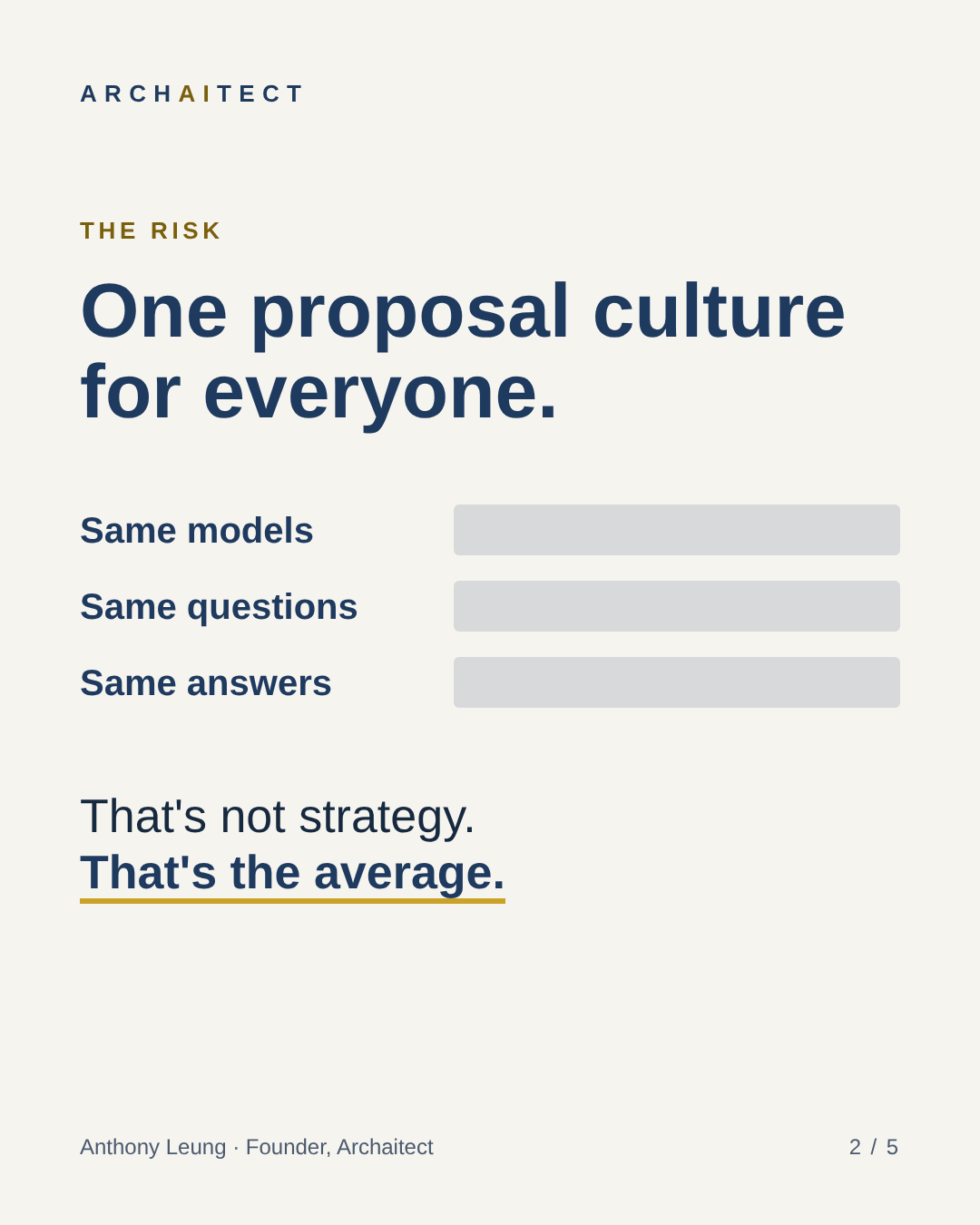
You can already see it happening. Business cases that read alike. Roadmaps with the same five themes. Transformation plans that could belong to any company in the sector. The analysis is better than ever, and the proposals are more alike than ever.
What makes a decision genuine
The word "decide" comes from the Latin decidere: to cut off. A real decision closes doors. It commits money, people and time to one route, and deliberately not to others.
In my experience a genuine decision has four ingredients that no model can supply:
- Context only you have. Your history, your customers, your past failures, what your people can actually carry.
- A trade-off you own. What you are deliberately not doing, and why.
- Conviction and timing. Knowing when to move, even when the data is not conclusive.
- Accountability. A name attached to the outcome. "The model recommended it" is not a governance answer.
AI can inform every one of these. It cannot own any of them.
Game-changing proposals come from your DNA
A game-changing proposal doesn't come from a better prompt. It comes from what the model doesn't know about you. That is your company DNA:
- Data and process knowledge nobody else has, often hidden in production systems, spreadsheets and the heads of experienced people
- What you have tried, and what you learned from failing
- Your capabilities, and the unusual ways you combine them
- What you believe about your market that others don't believe (yet)
The breakthrough happens where AI's breadth meets that DNA. AI is very good at showing you everything that is already known. Your DNA decides which part of it matters for you, and where you see something the market doesn't.
The catch: most companies have never made their DNA explicit. It lives in culture, habits and a few key people. That works for colleagues who have been around for years. It does not work for new colleagues, and it does not work for AI.
How to formulate your own direction
- Start from the end goal. The BHAG sets the direction. Work back from it, not forward from what happens to be available. At Archaitect we build software the same way: start from the stated end goal and work back to the requirements. Strategy deserves the same discipline.
- Make your DNA explicit. Write down your principles: what you stand for, what you won't do, how you make trade-offs. Turn tacit knowledge into data and documented principles. If it only lives in people's heads, neither your teams nor your AI can use it.
- Use AI for the consensus view. Let it show you what everyone else will do, then decide where you deliberately deviate. That deviation is your strategy. Ask the model to argue against its own proposal, or to give you the contrarian option. Then make the call yourself.
- Test it against reality. Can your architecture, data and people actually deliver it? A bold direction on a weak foundation stays a slide.
- Record the why. In architecture we use decision records: what we chose, what we rejected and why. Leadership teams should do the same. If you can't write down the reasoning, it isn't your decision yet.
That last step matters more than it seems. Writing a concept is cheap now. Understanding it, believing in it and executing it are not. Buy-in has become the expensive part, so give the people downstream room to challenge the concept, not just implement it. A written record of the why is what makes that conversation possible.
Strategy and technology are one conversation
More and more, your company DNA lives in your systems: your data, your processes and the context you feed into AI. If that foundation is generic, your output will be generic too. So strategy and technology can no longer be separate conversations, held by separate people in separate meetings.
That is where we work at Archaitect. We help leadership teams translate their vision into architecture principles, roadmaps and data foundations. We make the knowledge that sets a company apart usable, for people and for AI. And we help set up the decision structures that keep ownership where it belongs. Strategic where it needs to be, technical where it has to be.
The decision is the advantage
AI has made the road to a decision cheap. That doesn't make decisions less important. It makes them the thing that sets you apart. The companies that win won't be the ones with the most AI. They will be the ones whose leaders are clearest about where they are going, know what makes them different, and stay accountable for the call.
So here is my question to you: what part of your company DNA would no AI ever come up with?
Want to turn your vision into architecture principles, a roadmap and a data foundation that are genuinely yours? Let's talk.