A demo takes an afternoon. A working product still takes architecture.
What I learned in a year of turning a demo that did nothing into a working platform core, and the way of working that came out of it.
A demo that did nothing
When I started working with a recent client, the idea for a new back-office platform had been around for at least a year: one platform to replace a patchwork of older systems. Everybody had a picture of it in their head.
What there was to show for it: one demo website. It had colours and phrases. It had no functional requirements, and it didn't do anything.
That demo wasn't useless. It showed what people hoped for. It just didn't show how anything should work, or how the pieces should connect. A loose mix of ideals, with nothing practical yet.
Why the demo existed
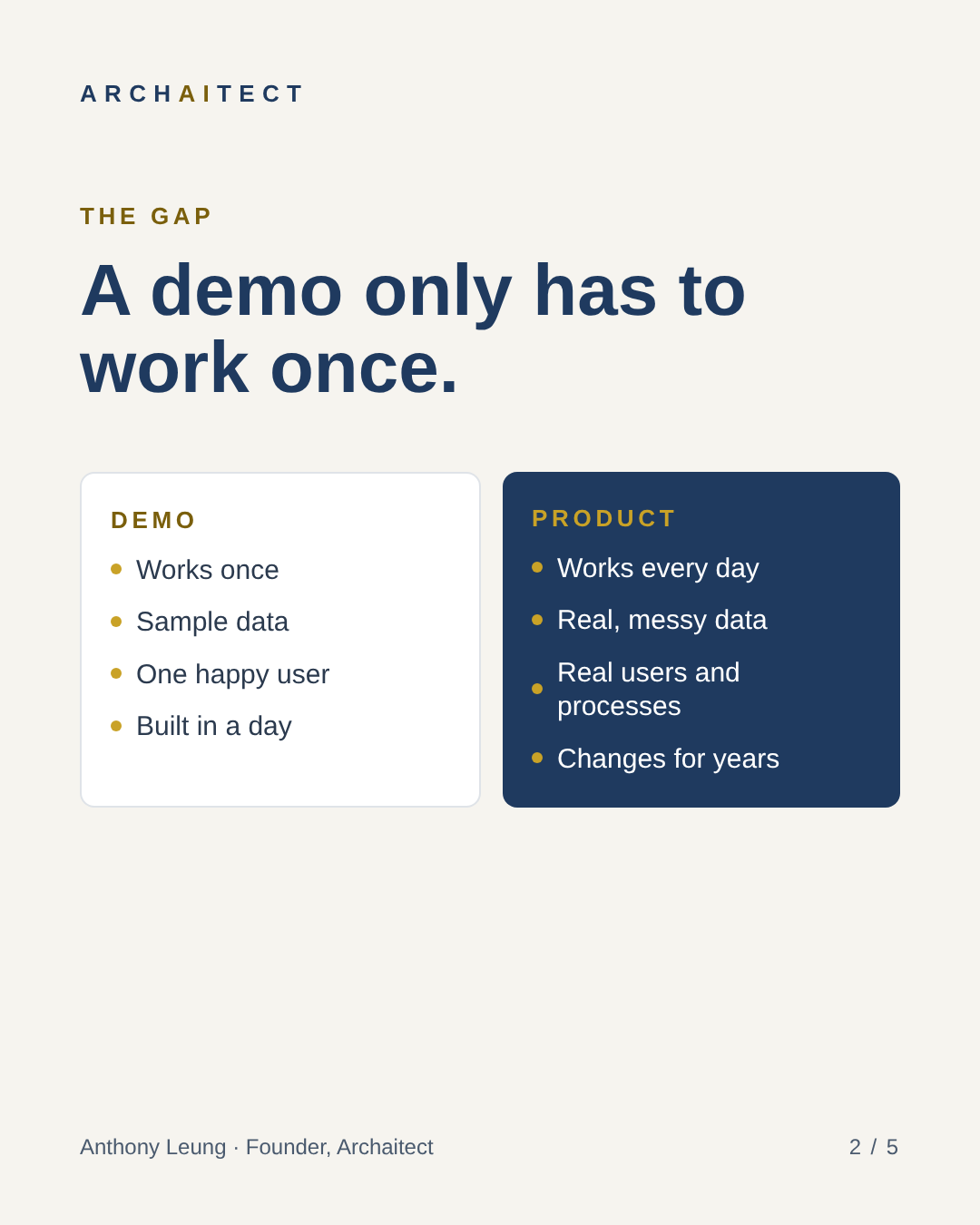
So I asked why it had been made. The answer was revealing. People had run into frustrations with the old systems, and someone had built a better version of one feature: a wireframe here, a standalone component there. None of it was ever integrated. Each piece solved one frustration on its own, and nothing connected them.
I see the same pattern in many AI demos today. They show a better future for one screen, and skip the hard part: how it fits with everything else.
Requirements come from watching, not talking
Next I asked how the work actually went in the old systems, and then I watched people do it. Frustrations that never came up in meetings were obvious within minutes of watching someone work.
One stood out: bugs that were reported and never picked up, and the waiting and operational delays that followed. Nobody puts that in a demo. You only see it in daily work.
So the new platform got a ticket system at its core, and someone actively watches it. AI triages new reports and drafts a solution for the engineer who picks it up. The engineer decides.
AI drafts, people decide
We also changed how the platform itself was built. Every new feature or fix started with an intake conversation with an AI agent. A person starts the conversation and brings the context and the decisions. When the goal isn't clear yet, the agent asks questions and proposes options to choose from. The person steers the direction, and has to stay critical about what to accept.
That conversation produces scenarios: in plain language, how the system should behave. We agree on the scenarios ourselves. AI turns them into code and tests.
Validate by watching
Checking the result is where things changed most. Each scenario runs as an automated test that is recorded as a short video, with subtitles and a voiceover added. Instead of reading code, the business watches the feature do what was agreed.
Those videos are kept for every release. For each part of the application you can see how it behaved in one version and in the next. Regression checks become visual, and people outside IT can do them too.
Where it stands
When my part of the work ended, the platform was not live yet. That is an honest part of this story. What is finished is the functional core: the part that has to be right, and that the team can now keep building on themselves. The user interface still needs polishing, and that doesn't need an architect.
That is what getting from demo to product means to me. Not a big launch, but a foundation that works, that the team understands, and that can grow without starting over.
AI made building faster. It didn't make thinking optional.
The speed is real. But it moves the work: from typing code to understanding the work, specifying the behaviour and checking the result. Organisations that see AI as a way to skip that thinking end up with more demos, not more products.
Storyreel
The way of working from this project is becoming an Archaitect framework, under construction under the name Storyreel: every user story turned into a reel anyone can watch. Intake with an AI agent, scenarios in plain language, AI-assisted building, validation by short videos with subtitles and voiceover, and a visual history per release.
Curious what Storyreel could look like for your team, or have a demo that needs to become a product? I'd be glad to give you a live demo. Yes, a demo, but one that works. Or just call me and we'll talk it through.